Can a Void Method Have a Return Statement
A method returns to the code that invoked information technology when information technology
- completes all the statements in the method,
- reaches a
renderstatement, or - throws an exception (covered later),
whichever occurs beginning.
You declare a method's return blazon in its method declaration. Within the body of the method, yous apply the return statement to render the value.
Whatsoever method declared void doesn't return a value. It does non need to comprise a render argument, only it may do and then. In such a example, a render statement tin can be used to branch out of a control flow block and go out the method and is simply used like this:
If you try to render a value from a method that is alleged void, you volition get a compiler error.
Any method that is non declared void must comprise a return statement with a corresponding return value, like this:
The information blazon of the return value must friction match the method'south declared render blazon; you tin can't return an integer value from a method declared to return a boolean.
The getArea() method in the Rectangle Rectangle grade that was discussed in the sections on objects returns an integer:
// a method for computing the area of the rectangle public int getArea() { return width * height; } This method returns the integer that the expression width*height evaluates to.
The getArea method returns a primitive type. A method tin can likewise render a reference type. For example, in a program to manipulate Bicycle objects, we might have a method like this:
public Bicycle seeWhosFastest(Bicycle myBike, Bicycle yourBike, Environment env) { Bicycle fastest; // code to summate which bike is // faster, given each cycle's gear // and cadence and given the // environment (terrain and wind) return fastest; } Returning a Class or Interface
If this section confuses you, skip it and return to it afterwards you take finished the lesson on interfaces and inheritance.
When a method uses a grade name every bit its return type, such every bit whosFastest does, the class of the blazon of the returned object must be either a subclass of, or the exact class of, the return type. Suppose that you have a class bureaucracy in which ImaginaryNumber is a bracket of java.lang.Number, which is in plough a subclass of Object, as illustrated in the following figure.
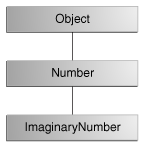
The class hierarchy for ImaginaryNumber
Now suppose that you have a method declared to return a Number:
public Number returnANumber() { ... } The returnANumber method tin return an ImaginaryNumber but not an Object. ImaginaryNumber is a Number because it's a subclass of Number. All the same, an Object is non necessarily a Number — it could be a String or another type.
You lot can override a method and define it to return a subclass of the original method, like this:
public ImaginaryNumber returnANumber() { ... } This technique, called covariant return type, means that the return blazon is immune to vary in the same direction equally the subclass.
Notation: Y'all too can use interface names as render types. In this case, the object returned must implement the specified interface.
Source: https://docs.oracle.com/javase/tutorial/java/javaOO/returnvalue.html
0 Response to "Can a Void Method Have a Return Statement"
Post a Comment